
Inside A20330: How Our Heavy-Duty Aluminum Foil Fabric Handles Extreme Temperatures
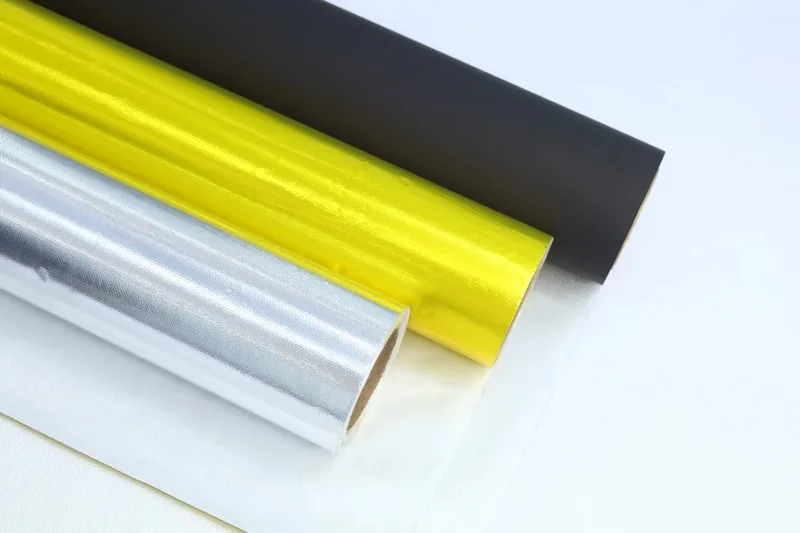
Anyone who's wrapped insulation on industrial pipework has seen it happen: after one summer, the aluminum foil facing starts bubbling, delaminating, or peeling off entirely. The culprit is usually one of two things — foil that's too thin to survive repeated thermal cycling, or bonding adhesive that gives up at sustained high temperatures.
These are not "close enough" applications. That's why A20330 exists. It's the heavy-duty model in our aluminum foil fiberglass fabric range.
Three Layers, Each With a Specific Job
A20330's construction isn't complicated — just three layers working together:
- 20μm pure aluminum foil. More than double the thickness of the common 9μm foil. Thicker foil resists fatigue cracking through repeated heat cycles, and delivers ≥95% reflectivity for radiant heat.
- Custom-formulated bonding adhesive. Engineered in-house to hold from -40°C to +260°C without delamination. This is where most aluminum foil fabrics fail — the glue gives up before the foil or fabric does.
- 260g E-glass fabric base. 12×6 warp/weft density, Class A1 non-combustible. Feels like heavy canvas in your hand, but open flame won't ignite it.
Pressed together, the finished product weighs 330g/m² at 0.3mm thickness. The price differences you see across suppliers in this product category come down to exactly these three choices: pure vs. recycled aluminum, high-temperature vs. general-purpose adhesive, and actual vs. claimed fabric weight. A20330 is specced for heavy-duty service, not for the lowest bid.
Where It's Used
Pipe insulation cladding, equipment heat shields, exhaust wrapping — anywhere you need both fire-rated thermal protection and a moisture barrier in one layer. The aluminum face reflects the majority of radiant heat back. The fabric base handles the structural and fire-safety requirements.
Because aluminum foil is inherently impermeable, A20330 also functions as a vapor barrier. Wrap it over your insulation blanket and you get two functions in one pass: radiant heat reflection and moisture protection.
Why 260g for the Base Fabric?
Base fabric weight determines two things in the field: installation handling and long-term durability. Too light (120-180g) and the fabric is floppy. Too heavy (400g+) and it's stiff. 260g is the balance point we settled on after years of client feedback — flexible enough to wrap cleanly around elbows, flanges, and odd geometries while providing enough tensile strength for the job.
Key Specifications
| Width options | 1.0m, 1.2m, 1.3m, 1.5m (custom widths available) |
|---|---|
| Chemical resistance | Acid-resistant to pH 3. Strong alkali or continuous immersion environments require separate evaluation. |
| Service life | Years under normal conditions. Critical: avoid scratching the foil surface during installation. |
| MOQ | ≥1,000 sqm. Sample rolls available: 15cm × 100cm. Free samples for evaluation. |
| Model comparison | TA9140 (9μm foil): standard HVAC. A20330 (20μm foil + 260g fabric): heavy-duty industrial. |
Need specs or a sample?
Contact our engineering team for the full A20330 datasheet, pricing, or a sample roll.
Request Sample or Datasheet